
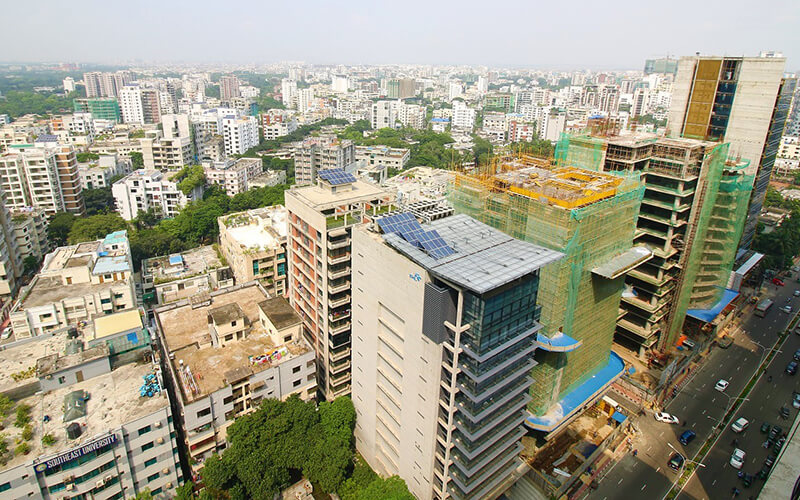
Overview of real estate industry in bangladesh
The real estate sector in Bangladesh is one of the fastest-growing sectors in the country. The sector has seen tremendous growth in recent years, with the establishment of a number of new real estate firms and the development of new projects. The sector has also been supported by a number of government initiatives, including the provision of tax incentives and the development of several special residential and commercial zones for the real estate sector. The sector has created a large number of jobs and has contributed significantly to the country’s economy. The future of the sector looks bright, with a number of new projects in the pipeline and a number of investment opportunities.
The country’s urban population is expanding rapidly, and there is a growing demand for housing, office space, and other commercial property. Apartment complex builders, model town developers, shopping centre developers, major infrastructure builders, and commercial building contractors—all with an eye toward making a tidy profit—fall under the broad category of “real estate” in today’s Bangladesh. The government has been encouraging private investment in the real estate sector. The real estate sector offers a number of opportunities for investors, and it is expected to continue to grow in the coming years.
Real Estate industry in Bangladesh: History
Rapid economic growth, increased demand for housing, the emergence of a middle class, and rising per capita income have all contributed to the real estate industry’s steady expansion in Bangladesh. Although growth was slow at first, it all began in the 1970s with just five officially recognized companies. The business really took off and grew quickly from the early 1980s. By 1988, there were 42 different developers operating in the market. Due to rapid population growth, it became essential to accommodate more people into existing structures. Growing urbanization in Bangladesh, along with the country’s status as a developing nation, had left the government then unable to meet the housing needs of this population. There have been many ups and downs in the last 40 years as the real estate business has taken on the task of providing affordable housing for all members of society. The Real Estate Housing Association of Bangladesh (REHAB) was established in 1991 to standardize industry practices and promote consumer confidence in the industry.
Construction, building items, sanitary ware, electrical products, brokerage, designing solutions, and so on have all benefitted from the real estate industry in some way, either directly or indirectly, which has been a blessing to the economy. Millions of people have benefited from home ownership and rental opportunities in the past four decades, despite the constraints of available land.
Present Scenario of the Real Estate industry
One of the most promising areas for investing in Bangladesh right now is the real estate market. We may mostly attribute this to the increasing rate of urbanization. World Bank data shows that Bangladesh is now experiencing an annual rate of urbanization of about 3%. The urban population of Bangladesh currently accounts for approximately 38% of the country’s total population. There is a severe lack of available housing in all major urban centres, and this scarcity is expected to worsen as demand for new homes rises.
The present demand for housing in the country is estimated to be between 6-8 lakhs units across all major cities. The majority of Bangladesh’s urban population resides in Dhaka and Chattogram, hence these are where the majority of real estate development is taking place. Estimates show that there is a need for 60 thousand apartments in Dhaka alone, along with 2 lakhs more units of replacement and project delays. Compared to other cities in Bangladesh, Dhaka has been expanding at an unprecedented rate. As a consequence of this, there is a significant demand for plots and flat units. Both foreign and local investors are attracted to this market because of its large size and significant unmet demand.
In the real estate industry, all the firms essentially provide the same service: land and apartments. There are companies that specialize in either one or the other, and others that offer both. However, the offering is always the same: accommodation. Differences in quality and service can’t be drawn from the products themselves. Differences in variety, quality, design, features, and luxury brands are what set land and apartments apart in this case. Although there are more than a thousand firms operating countrywide, only a select few excel in providing exceptional service to their clients.
Leave Your Comment